This will likely be an earnest, though potentially infrequently updated, account of my adventures, tribulations,
and everyday experiences as I spend two years working as an environmental Peace Corps volunteer in Fiji

You'll actually look forward to your morning commute. Life is calling. How far will you go? Learn more about the Peace Corps

Saturday, August 31, 2013

8 Months in 8 minutes! (well, maybe 88 minutes)

To my three potential blog followers:

Please forgive my eight month foray into the land of unmotivatedness and for not posting any news about my many adventures whilst living under a rock.

Effective immediately, I am initiating a blogging do-over (or maybe just a recharge?) and vow to at least attempt more earnestly to update my blog with interesting pictures and stories. So, until I can come up with an interesting story, here's a slew of pictures from the past eight months that are not necessarily in any particular order and my be slightly shoddy due to the fact that my camera was stolen sometime around mid-April. And, yes, you should give me credit for taking pictures without a camera.

But first, a quick update: I have completed my two year service with the Peace Corps and have since moved out of my village. However, I applied for a third year extension in town and it was granted! So, now I'll be the same old integrated environmental resource management volunteer, ahem, that I always was but now working at the provincial office in town I'll be able to conduct workshops and trainings on the good stuff in communities all throughout our province!

Found this juvenile reef shark caught in someone's longline.
Just like it sounds - a longline is a length of fishing line with hooks spaced at various intervals that the fisherman puts out for a few hours or overnight and then returns later to collect what is caught; they are prone to bycatch, especially sharks and sea turtles. There are no established rules in Fiji regarding the use of longlines (with exception to adhering to lawful hook sizes) but sadly this was the third time I came across a dead shark. The first time was with a large female reef shark that was pregnant with 12 pups - all of which died. Awareness about this sort of thing is all part of the job but the full message doesn't always make it across.

Working with some of my villagers to create a miniature sea cucumber raising pen.
Eventually, with assistance from the Ministry of Fisheries, we will create 4 pens that are approximately 100 m2 and will each house approximately 1,000 sandfish sea cucumbers. The goals behind this are:
  • A) to stop harvesting these highly lucrative (in the Asian markets) sea creatures from the deteriorating reef and thus help the wild populations and the reef recover; 
  • B) to act as a sustainable income generator - after two years, the villagers will be able to harvest these sea cukes instead and will be able to raise upwards of $50,000 in the process; and 
  • C) to give added motivation for the locals to continue to respect their tabu area, as these pens will be situated inside and are an investment.
                                                                         ~~~

My counterpart and I worked together on creating an official sign that would declare the boundary of our permanent marine protected area. We didn't have any colorful paint at the time except a primer that made things look pink when applied so... (I edited out our village name)

'Our' Village Marine Protected Area - Fishing and Anchoring are Forbidden

My counterpart jumping off the beacon marking the southeast corner or our tabu area. The beacon marks the channel that leads into a nearby harbor. Meanwhile, I'm speeding around in the boat threatening to ride over to Taveuni (in the distance).
We thought the orange cone would make it a bit more noticeable in an important sort of way to any yachts or fishing vessels that might be anchoring in the neighboring harbor.

                                                                                 ~~~

Within the past few months, my village community became active in the provincial sports league. The guys formed a rugby team that they train with every day and then on Saturdays travel to different spots around the province to play against other villages. I was having fun watching and rooting our team on until the women decided they were going to start up a netball team for competing as well. They asked me to join, which I was stoked to do (it's not like I have much opportunity for displaying athletic ability whilst wearing my ankle length skirt and hand washing laundry like a good lady of the village). Then I realized I don't know how to play netball. Then they made me the starting center. K...

The village rugby team playing in a weekend tourny up the coast.
Playing in a netball tourny! If you squint you can see me kind of in the middle in the back wearing black - I'm the one with white skin.
Netball turned out to be a ton of fun! It's kind of a crossover between basketball and ultimate frisbee. If you have the ball you can't move with it but have to pass it on and the hoop has no backboard so there's a lot of swishing involved. Luckily, my job was not to shoot but rather to run up and down the field trying to do everything else. We didn't win many tournaments but I had tons of fun looking foolish anyway. And most tourneys ended with a grog drinking dance party!

 ~~~

This last semester that I had with the kids I decided to take on a new topic - world geography. Most kids in Fiji have a difficult time visualizing the other islands within their own country let alone have any perspective on where America is in relation to Europe. The word for a white person is kaivulagi, which means native of a strange land but is translated as European. It doesn't matter where you are actually from; if you're white, you're a European.

So, I decided to become part of the World Map Mural club within Peace Corps and initiate said project with my class 7 and 8 students at our primary school.

The origin of the world map project in Peace Corps:
http://www.peacecorps.gov/resources/media/medstories/1536/
  

The beginning. This is the concrete wall of the primary school's outdoor bathroom. My counterpart and I measured out a 2:1 rectangle, taped it off and painted the interior with the bluest paint we could find. I know... it looks grey, but you work with what you got!

Once the area was prepped, I laid out a giant grid that the students then used to carry out task number 1: drawing the map.


Once the map was completely drawn, we began phase 2: painting! Hands down the best part of this whole thing. The kids really got into. We painted one color each day - that way we didn't risk two neighboring countries blending their colors.
Slowly but surely the colors began to show...it almost looks like a real map!
This is more or less the completed map! We still want to put the Fiji flag in the upper left hand corner and fill in the Peace Corps symbol in the upper right.
I was super proud of the kids and the work they completed and the enthusiasm they had for the project. I lied about the best part being painting it - the best part was having all manner of students come up to the map and quiz each other on geography and get excited and surprised when they saw how far away certain countries are from each other or how big they are. It was perhaps one of the most satisfying things I've been able to do while serving here. Seeing them so excited about this thing that they could use and learn from was amazing!

The last day we had a jeopardy party! Three teams - 2  boy teams and 1 girl team. I'll give you one guess which team won.
Working on an all play question - so it wasn't exactly like jeopardy...
Our project group!


                                                                             ~~~

During my last month in the village we did our last tomitomi (picking up trash) day with the village kids. So, being that it was the last one everyone and their mother came out to participate. Seriously, kids were coming out of bushes and sliding down coconut trees. Eventually, we had somewhere close to 35 kids marching along our village road in a rambunctious parade. Shockingly, they still managed to pick up trash and not just run around in a wild frenzy.

Two of the kids working together to put the right trash in the right bag.
Little Viwa! Always wants to carry the trash bag.

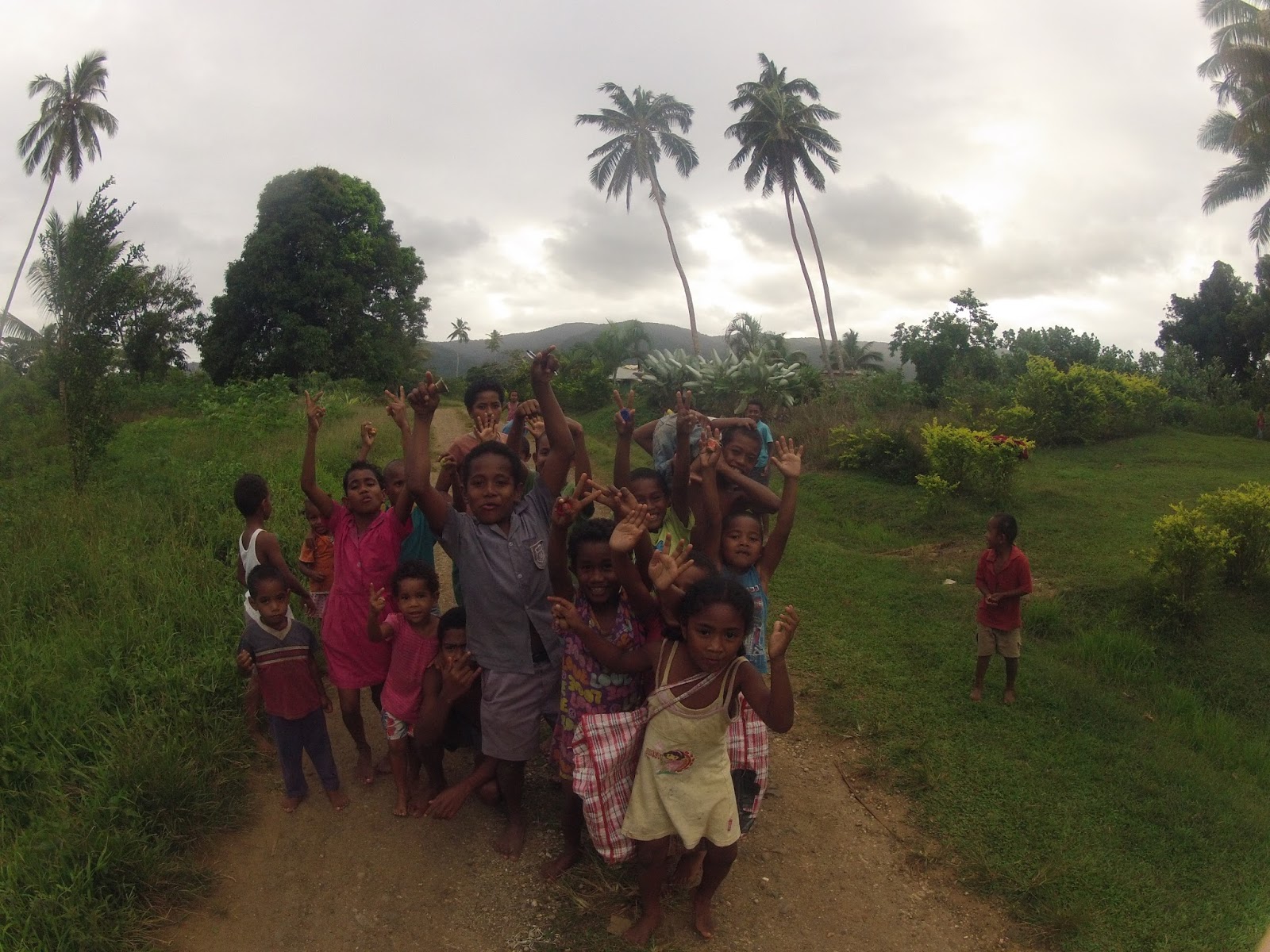
Group shot! I think half of the group was off running amok.

Here's most of them just dying to break down my porch and swarm into my house to get their toys! That was a challenge... but luckily I had some friends come to my aid - you know the kind that can actually communicate in Fijian.


Me and my little namesake! Kirisitina (Christine turned Fijian - just throw a vowel between every constant and one at the end)

                                                                              ~~~

So before I could depart from my village, the place that I called home for two years, we had to partake in all manner of ceremony and partying to "properly send me off." The first part involved me presenting my itatau, which is typically a gift of a bundle of grog, to my chief and community. I speak about my time with them, how they've made me a member of their families, about the work we've done together, about my hopes for their future, and an apology for any of my own misdoings during my stay - that's the basic recipe for the goodbye speech. The chief will accept this and speak in turn. Then to seal the deal, of course we partake in a bit of the grog I presented.


The grog that I presented at my going away ceremony for the village.
I repeat this process with any number of close friends and families that deserve a special parting as well as with the school. Often they will do something in turn such as preparing food, speeches, and gifts.

The going away ceremony performed for me by the school. I presented grog and gave a speech and they returned the speech and prepared dinner.

Master Vavi - he was my counterpart for our coral farming project last year.
 My final day in the village was spent at a giant party with all the members of my community present. They presented me with kuta mats, prepared a feast of a dinner, and even agreed to lift the ban on dancing so we could make it a real party! I gave another speech; they gave more speeches. Much grog was drank and food eaten. I had blisters on my feet the next morning from dancing so much.


The high table for my going away party in the village! Only the chief and the elders sit up here. I was included because I was the guest of honor.

That's me on the right and my chief on the far left. The village presented me with three hand woven kuta mats (kuta is that rare swamp grass that gross some places in Fiji, and is considered more valuable than other types of mat - our village is known for it).

The women and children at my party, just hanging out and waiting for the party to begin!

And then came grog. Closely followed by dancing! :D
The next day was my last in the village and was very brief. Many tears were shed - though in Fiji it is tradition to force cry at a supposedly sad event because they say it makes it pass easier and won't invoke bad spirits. So I'm not sure whether my friends were actually tearful to see me go and couldn't help but cry or whether they were turning on the water works so no bad spirits would come for them and their seemingly hardened hearts. Either way it didn't matter much to me as I surprised even myself by bursting into tears as everyone came up to hug me and wish me on my way. My hired ride showed up and we packed up all my belongings into his pickup and off I went to my next job and adventure in town!

Stay tuned - more to come!

Sunday, January 13, 2013

Coral Farming with Kids!

So last I had updated you about our environment club at the school (the umm Big Fantastic Club), we had been having sessions to learn about and explore coral reef ecosystems. Well, this was the final trimester of the year and my last chance to work with the class 8 students who, beginning in January, would be moving on to board at secondary school. So as a group, we decided to apply our newfound knowledge of coral reefs by initiating a coral planting project.

This is a fairly inexpensive and straightforward process and if applied on a larger or more professional scale is an efficient method of recovering damaged coral reefs. For our purposes, however, I just wanted the students to get a more tangible sense of what coral looks like up close and that hopefully, by nurturing their own small bit of coral to grow they might gain a better respect for coral reefs and a better understanding of why they’re important.

First meeting of the term where we talked out our plan for the next three months.

Step 1: Making the sand plot

In order to plant bits of coral, we needed some kind of base that the coral could grow from and that could also be used to attach it to the reef when the coral was ready to be replanted. The bases that we decided on were cement pancakes with a little divot hole in the top (to attach the coral fragment to using a marine epoxy) and a stick like appendage extending from the bottom that can be used to secure the pancake to the reef.


To make the pancakes we needed a nice open sandy area where we could pour the cement. The students took to the task with gusto – clearing and preparing a nice sandy patch close to the beach. Once we had the area set up, we poured water onto it to make it damp and proceeded to make small shallow holes that would serve to create the stick appendage. 

Digging our sand plot, where we would create our cement pancakes.

The sand needs to be smooth in order to create nice even pancakes!

Working together as a team

The class 5 and 6 teacher helping out on pancake making day. The sand needed to be moist in order to keep the form of the cement.
Using a stick to push small shallow holes into the wet sand. These would create the stick-like handle on the cement pancake that will hold it in place in the cage and then later when it is placed on the reef.
 
Finally, we mixed up the cement (cutting it with a bit of sand) and poured it into each of the little holes the students made, adding a little extra at the top to serve as the pancake. Once they were set a little bit the students carved their names into them.

Students pouring their own pancakes

Batch number one cooking in the sun!

Step 2: Placing the cage

Having our pancakes prepared we needed to set up our nursery in water that was shallow enough for the students to reach but deep enough to substantially cover the corals at low tide. It took nearly 20 minutes of walking into the water but eventually we reached an appropriate area. The students had carried out a large sheet of mesh that would serve as our nursery structure. We also carried out a flag to mark the location so we could find it again!

Signing our BFC flag that would mark the location of our cage in the water - the spot where the corals would go to grow

Marching out to place the flag and the cage

This is our cage or rather its a bit of hurricane mesh that I acquired from another Peace Corps' house. We elevated it up on some rocks and placed more rocks around the borders as weight so that it would remain stable in rough weather.
Step 3: Harvesting a bit of healthy coral

Class 8 students that had received permission from both their parents and the head teacher were allowed to participate in the field trip out to the reef break to harvest our healthy coral stock. It would take one person all of 5 minutes to acquire enough appropriate coral for our purposes but none of these students had ever been out to the reef before and had never seen a coral reef ecosystem in person. I wanted them to have that experience. 

Taking the class 8 students out to the reef break at the nearest passage. The location we chose is particularly healthy and a good site for harvesting a few pieces of coral to use in our project.
The site we had selected was ideal as well because it was nice and shallow with an excellent selection of healthy corals and then it led to an abrupt drop off leading into a wide passage – it looked just like the drop off in Finding Nemo. Having a bit of blue water like that allowed the kids to see some big fish as well including a few barracudas and a shark! Altogether, we collected appropriate pieces and gently piled them in a bucket for transport. 

Collecting corals
Back on the boat - we filled the bucket with more water and kept the corals nice and covered until we planted them promptly afterward

Step 4: Planting in the nursery

Finally, we had everything we needed to plant our corals. Each student had a pancake and would receive a small piece of coral fragment (broken off the larger healthy branches that we had collected) that would be glued to the top of the pancake using a special marine epoxy that hardens underwater. Once each student had his or her fragment attached, we marched as a group to our cage nursery and planted them!

Showing off their pancakes!
Attaching pieces of coral to each pancake using a special marine epoxy. The students brought their pancakes one at a time and I glued on the coral fragments. Once they were set, the kids took them to the water to keep the corals underwater until everyone was ready to march out to the cage for placement.

Sadly, however, a lot of students lost their coral fragments because they were playing a bit too much on the way out and in the end we placed a mere five pancakes in the nursery! Isa lei. But the point wasn’t to establish a highly efficient and productive coral recovery farm but rather for the students to go through the hands on process and in doing so attain a better connection to the marine environment. 

Showing off their corals and looking like little rock stars in my swim goggles.
A few of the successfully placed corals.
Step 5: Celebrate!

Now usually, at this point in the coral planting process you would let your corals grow in their nursery while carefully tending to them and keeping them free from harm. Once they reach a good enough size to ensure a fighting chance of survival on the reef, they would be transplanted. However, we finished our project just about the same time as term ended and the students would be leaving on break. So sometime during the next term we’ll take a trip out as a club again (without our class 8 students) and see if our few corals have survived and grown big enough to transplant.

Once again, I’m mostly just pleased with the kids’ enthusiasm during the project and that they were able to have this experience. Naturally, the last thing we had to do was celebrate the completion of our project and the end of term! So what kind of fun water related activity could I get the students to partake in? Something they’d never done before? Water balloon fight anyone?

Balloons and students - both ready to go!
The kids went absolutely nuts having a water balloon war! We filled up around 300 balloons (a far cry from the amount that I was hoping for but all the more reason to do it again) placed them in basins on the steps of the school and said go! Everyone was completely soaked, bystanders included and it was all over within 5 minutes but the kids loved it! We’ll definitely be bringing this activity back. 

The fight begins!
 
All in all, I hope that my year with the kids and our environment club has left them with a little more knowledge and respect for their own environment and I hope (though I feel pretty sure about this one) that they had fun during the learning process. Until next term!


Saturday, January 12, 2013

Wait...What?!


Sorry it's been so very long! My longest stretch yet! But I have this fun little story that I just wrote for our in country volunteer newsletter and will hopefully be following up with a post about our coral farming project with the kids. 

~~~

We’ve all been there. Whether you’ve been serving in Fiji for two months or coming up on two years, I can just about guarantee that you’ve experienced a moment like this. It starts, for instance, when you’re sitting enjoying a nice cup of sugar with a friend when something happens or something is said that is either: a) surprising, b) confusing, c) urgent, or d) all of the above. Naturally, this also takes place in rapid Fijian probably at a high decibel with lots of gesticulation making you wonder if a tidal wave of molten lava is rapidly descending upon the village when your Fijian catches up to you and you realize they’re yelling about there being too many flies so we better hang a plastic bag full of water.

Wait… (you pause with a look of consternation on your face trying to figure it out but fail miserably)… what? Being that that made no sense whatsoever you perhaps are hopeful enough to ask for clarification. They repeat what they were shouting. You sigh and decide to just give up and accept that you will never know why hanging a plastic bag full of water will have any relation to the number of flies in the immediate vicinity or why it warranted apocalyptic shouting and gesturing. These instances happen with varying frequency for each of us but the real ‘wait what’ situations are the ones in which you are not simply a bystander to the baffling behavior but rather the focal point of it.   

One fine Sunday I was peacefully zoning out in the back section of our church during the morning service. It was youth day apparently, which induced more people to appear in their Sunday best than I even knew we had living in the village. Naturally, service extended on for another good hour but I was aware when the preacher had finally reached the last stage and fresh air was just another minute or two away.

As the man was waxing on about some other thing the people were doing wrong, the girl (my age) sitting next to me abruptly leans in and begins to whisper to me in rapid fire Fijian in a very urgent manner. Snapping out of my reverie, I stared blankly at her not having taken in a word she said, arched and eyebrow and replied, “a cava??” All the while wondering what the hell could have happened during the two hours we sat next to each other in silence to make her absolutely need to speak to me two minutes before we would be outside and free to speak anyway.

She began whispering at me again with such vehemence that it sounded like there was a small tank of helium being slowly reprieved of its gas nearby. Meanwhile everyone in the three rows in front of us and the three rows behind had stopped what they were doing to listen in and to nod their heads in agreement (we were sitting in more or less an all women’s section). This time I picked up what she was saying:

“Tina, as soon as he finishes speaking you have to get up and run outside to Mita!”

“Wait…what? Why? Where’s Mita?”

“She’s standing outside waiting for you!”

“Why do I have to run to her?”
“Because they’re going to be running after you.”

She says this and gestures towards the section on the other side of the aisle where all the men are sitting. When I look over I notice with some concern that they’re all shuffling and twisting around and looking antsy. I can tell that some of them are overhearing our conversation and don’t look happy about it. What the hell is going on?!

I tried once more to say “Wait…what??” but just as I got the words out the man up front finished speaking.

“Go Tina! Quick! Quick!” They all start yelling, no longer trying to be discreet. They shove me into the aisle and as I start to speed walk along I turn around looking at them for confirmation that I’m doing what they want and catch a glimpse of the group of men charging at my heels. Holy hell! What is going on?!

I get out the door and pick up my pace when I see Mita standing some twenty feet away with a dish in her hand, perched on a hill like Vana White. I make a beeline towards her and manage to get to her first. She then hands me the dish, which is mounded up with all sorts of holiday type food, and as she does so I notice all the men that were seemingly seconds away from a tackle cut their momentum and slink away looking dejected. The women just making their way out the door all cheered. Then everyone went back to being normal and I was left standing there with a mountain of food completely lost and having a heart attack.

Assuming that the plate of food was mine for whatever reason (though I’ve learned not to assume much in Fiji), I began to make my way home. On the way, I was stopped by an old man who told me a bit sternly that that plate was mine and that I had to take it to America. At first I thought he meant with the food on it but either way I just nodded and agreed with him – of course that’s what I was planning to do all along.

I was called over to my friend’s house for lunch so I brought the giant dish of food to share hoping to ask my friend about it. When I broached the topic trying to convey my confusion, she explained it to me in a ‘duh why don’t you know this’ sort of manner:

“Tina, don’t you know Merelita?”

“Yeah, I suppose.”

“It’s her newborn’s first church service.”

“Ok…”

“Us Fijians are like that Tina.”

She was done talking having explained it fully.

“Wait… what?”

But I didn’t get anything more coherent than that out of her. It took me a while to figure it out on my own but I think I got it. My assumption is that in Fiji, there’s a tradition that if it’s your newborn’s first mass, then you have to prepare a dish of nice food and give it to the first person to exit the church, probably for good luck. I’m also assuming that the women just wanted me to get out of the door and over to Mita first so that I would get the food even though everyone else was eligible had they arrived first. That’s my best guess anyway. It’s also the most baffled I’ve ever been in Fiji, though it wasn’t the first time and certainly won’t be the last. It’s those ‘wait…what?’ moments that really remind you sometimes that you are serving in a completely different culture than your own and though it can be frustrating it can be thoroughly entertaining as well!  

Tuesday, September 25, 2012

How to Create a Locally Managed Marine Protected Area


**Fair warning in advance – this is a really long post. It details the primary project I’ve been working on during my past eleven months here at the new site. I’ve told you all the nonsense I get up to when I’m not working, it only seems fair that I share the other half of my life here.


When I first came to this village after having so abruptly left my last site, I remember being worried about having to adjust all over again and fearing that they would expect miracles from me upon the moment of my arrival. I just wanted to unpack and at least learn the name of the village first.

The first morning I spent in my new house I was awoken at 6 am by some aggressive pounding on the railing of my porch. I had to fight my way through all my belongings littered about like I was auditioning for a game show on Japanese prime time. Groggy, disheveled, and as previously noted, a bit overwhelmed, I opened the door to find the village chief standing there cane in hand, giant glasses askew, and sporting a big gap-toothed grin that gave an overall impression of an elderly jack-o-lantern. I half expected him to start poking me with his cane as he began to speak.

“Tina, we need to meet today about the projects you’ll be working on. We’ll have to contact the turaga ni koro to get his involvement and you should really acquaint yourself with the village development committee leader as you’ll be working with him a bit and they have been asking about you down at the provincial offices and the Roko Tui would like to have a sit down to get a better idea as to what your plans are for the next 18 months. Here are some folders, books and materials that detail all of the work the previous volunteer accomplished for us and she left some specific guidelines as to how to carry on with these projects and ideas for other ones. And what are you doing sleeping so late? The children will be here any moment to brush their teeth!”

He said all this in a mix of broken English and Fijian and then gave the greatest laugh (though I didn’t think it was great at the time) – something like the count from sesame street but with more ‘yukking.’

Huh? The children will be coming here to brush their teeth? At 6 am? In my house? … All of them?? Confused and panicky about brushing teeth and lacking a comprehensive 18 month plan of action, I just sort of stood there wondering where exactly I should respond. I just hadn’t been serving in Peace Corps long enough to realize that ridiculous conversations like this that make me have an internal conniption about my apparent lack of value as a volunteer are just par for the course. Thinking back I think the chief was just trying to mess with my head, see if he couldn’t freak out the newbie for some before breakfast entertainment.

Anyway, in an effort to look on top of things (with my shirt on backwards), I started rambling on about the knowledge and experience that I had to offer and how in my last village we had been really interested in creating some tabu areas (marine protected areas) and…

Mid sentence the chief cuts me off with, “Oh, vinaka Tina, we’ll do that then,” and then storms off to accept an invitation to tea that someone shouted to him from across the village, yukking to himself all the while.

And based on that absurd discussion on my porch at 6 am, we soon began our project on establishing marine protected areas within the bounds of village owned waters... sometimes it’s not as professional or inspiring as you would think; even really important and influential work can have the most absurd beginnings.

~~~

Step 1: Form the committee

In the village, whenever a committee needs to be formed or a leader appointed to a project the villagers have a traditional way of choosing the appropriate people – during a village meeting the subject will be broached and the announcement made for people to step up; silence ensues until someone randomly shouts out another villager’s name and it is immediately seconded before any arguments can be made; then being decided, no one has to worry about the responsibility any more because now it’s so-and-so’s job.

For obvious reasons, being that I wanted the project to succeed, I decided to be a bit more deliberate about forming our committee so I called a meeting and invited a dozen or so individuals who spend nearly every day on the water, who know the area well and who would likely be the most interested in helping the project. I was showing a DVD on coral reef ecosystems in Fiji and apparently word got around that we would be running a generator to watch a movie because roughly 60 people showed up including children with pillows and of course grog. It was a regular movie night and, well, I guess the more awareness we do the better!

The following meeting was more successful as far as getting things accomplished; we managed to form a committee of interested individuals and proceeded to assign each one a role (leader, secretary, etc). The next day we started phase two – transect surveys.

Step 2: The baseline surveys

To get an idea for the overall health of the reef ecosystem that existed throughout our fishing grounds we, as a committee, went out on the water for two days to conduct surveys. Based on previous experience and having gleaned some useful knowledge from local resources, I devised a transect survey that considered four aspects of the environment to determine overall health:

            1) Corals – quantity and sizes; living vs dead; bleaching and disease
            2) Algae – quantity and patch size
                        - The more algae the less available real estate for coral
3) Invertebrates – giant clams, conch shells, crown-of-thorns sea stars, sea cucumbers
            - These first two being both ecologically important and thoroughly overfished
            - The COT sea stars are becoming over populated in our area and destroying                          corals
            - Sea cucumbers are also being heavily fished for their export value to China
            4) Fish – top predators (shark, barracuda, trevally, grouper) and butterfly fish
                        - Top predators are indicative of a healthy trophic system and thus ecosystem
                        - The presence of butterfly fish as corallivores indicates healthy coral growth

I created a makeshift underwater slate for each of these categories by stapling scrap water proof paper (that I had left over from an old school notebook) to peace corps provided laminated cards I would otherwise have used in an AIDS awareness session. Slapped a pencil onto each and voila. The transect I made by evenly hammering pieces of lead onto a 50ft length of clothesline that my brother sent me. Perfect leaded line!

One person per slate, we swam along the transect line up one side and observed our respective categories for 2 meters out from the line. Then we repeated this by swimming back up along the other side. Our entire fishing grounds (qoliqoli) is approximately 15 square kilometers, unfortunately, we only had enough boat time to complete 14 transects in randomly chosen spots throughout the qoliqoli. 

Coral that we hope may recover with some time under protection from feet and anchors.


About to go spearfish some lunch! Doing so many transect surveys can be make you hungry.

Nothing better than some fresh fish for lunch.
Sadly, I don't have any pictures of us doing transects or of the materials we used. All these pictures were taken on different trips but were more or less the same as the survey days.


Step 3: Choosing the area to protect

Once we completed our surveys, we compiled the data and, using a self designed ranking system, rated the health of the surveyed areas. We wanted to include healthy coral reef areas in our MPAs so that the damaged areas would have more success at efficient recovery (see # 4 below). But we didn’t simply make our decision for location based on this. We followed a list of seven criteria put out by NOAA, University of the South Pacific, and the FLMMA (Fiji Locally Managed Marine Area) Network:

            1) Include all different types of habitat in the managed/protected area
            2) Have several similar areas protected
            3) Protect areas that may be more resistant to hazard damage (bleach, cyclones, etc.)
            4) Protect more healthy areas over damaged areas
5) The areas should be big enough – at least 1/5 of the entire qoliqoli, with a minimum perimeter of 1 km x 0.5 km if possible
6) There should be buffer areas of spillover
7) Should include some permanent sites

Google map image showing the tabu areas and the locations of each transect survey we conducted to evaluate the reef health and choose locations.
On Boxing Day in the midst of festive meals, dancing, and grog parties, we met as a committee and hashed out our proposed tabu areas. These we then presented at the next mataqali (term for clan; most of the villagers are in the mataqali and there is only one in our village, everyone else is married in; the mataqali  makes all the decisions regarding land usage in the village) meeting, which was approximately three weeks later. After this it was presented at the bose va koro (village meeting) where it was discussed openly between all members of the village.

We had created a shoddy hand drawn map during our group sessions that we had used as a prop to discuss with at the meetings. During the bose va koro some villagers took the map at one point and started to draw new lines on it in different locations. Of course they were going back and forth in rapid Fijian, so I couldn’t really understand what the conversation was about until they turned to me and asked if it would be alright to create a second tabu area in this new location they demarcated (see the temporary tabu area on the map below).

…umm, yeah, that would be swell - !

Definitely not my shoddy hand drawn map showing the permanent (larger red area) and temporary tabu areas. Although it's not highlighted, the dark green area next to the permanent tabu shows all the mangroves that are also under protection.
Step 4: Get approval from the big guy

Well, we had succeeded in spreading awareness throughout the village and getting their overall support but it didn’t mean anything unless we got approval from the chief of chiefs of our province – Turagabale na Tui Cakau. He lives on Taveuni, the next island over.

It took another three months before we managed to raise enough money for our group to present our request to Tui Cakau. In the mean time, we went around to the families in the surrounding settlements and discussed our proposal with them to spread awareness and garner further support and respect.

On April 4th, we went for two days to Taveuni to make our case. In our traveling entourage we had two members or our committee, our village chief (who was crucial for speaking to Tui Cakau), a member of a nearby settlement who generously agreed to provide us with a whale’s tooth to offer during the ceremony, a giant sevusevu of bundled grog, and one squealing pig. Upon arrival on Taveuni we would be collecting ten pre-prepared bundles of dalo to present also.

Well, the pig died en route. We forgot the grog at the departing ferry landing point. Someone somehow forgot to call and tell anyone we were coming so there was no dalo ready for us and Tui Cakau was in meetings all day. Incredibly my two accompanying committee members pulled through by hiking into the bush and pulling three whole yagona trees and enough dalo needed to make the ten bundles (which they then did); they carried all this back down by themselves and proceeded to clean and prepare the recently deceased pig for cooking in an underground oven, which they also constructed on the spot.

By the time Tui Cakau was ready to see us it was almost 9 pm and the weather had taken a turn for the worse. A friend had agreed to drive us up to the big guy’s compound in his taxi and he apparently really meant drive us up. Tui Cakau’s compound is at the top of a small mountain and is only reachable by a narrow dirt road with steep drop offs on either side most of the way up. When we turned off the main road to start our ascent it looked as though we were driving into a wall, the grade was so steep. The torrential down pour was causing small, yellow rivulets of liquid mud to carve its way down the road; its pace seemed to be increasing. Sitting soaked in the backseat because my window was broken open, I was trying to see out the windshield with only one wiper half working just waiting for the dim headlights to jostle their way onto a tree or point suddenly in a downward position because the mud river we were driving up in this guy’s cab had finally swept us off the edge. 

After a few more minutes of speculating at our eminent demise, we arrived at the top and were greeted by an official big guy representative. Thirty seconds later we’ve turned around and are rafting our way back down the Yangtze because we were told that Tui Cakau couldn’t meet with us after all. Now normally this is when I would start to politely protest or aggressively demand that we do something because of all that it took for us to get here and we won’t be able to make this trip again anytime soon…dammit. But I’ve learned to just keep my mouth shut and see how events unfold themselves and low and behold when we had reached the taxi driver’s house again, where we were all staying, we got a call saying a rep would come down to us so we could do our presentation. 

After the gift presenting ceremony, my chief presented our proposal while I sat next to him acting the necessary part of a wall flower and just hoping everything was being said right. Well, we received our approval in the traditional sense and were told that Tui Cakau supported the plan but it wouldn’t be officially recognized until we present it at the next provincial qoliqoli meeting to be held the end of June. That way leaders throughout the province would know about it, could discuss it and agree as a group to support it. 
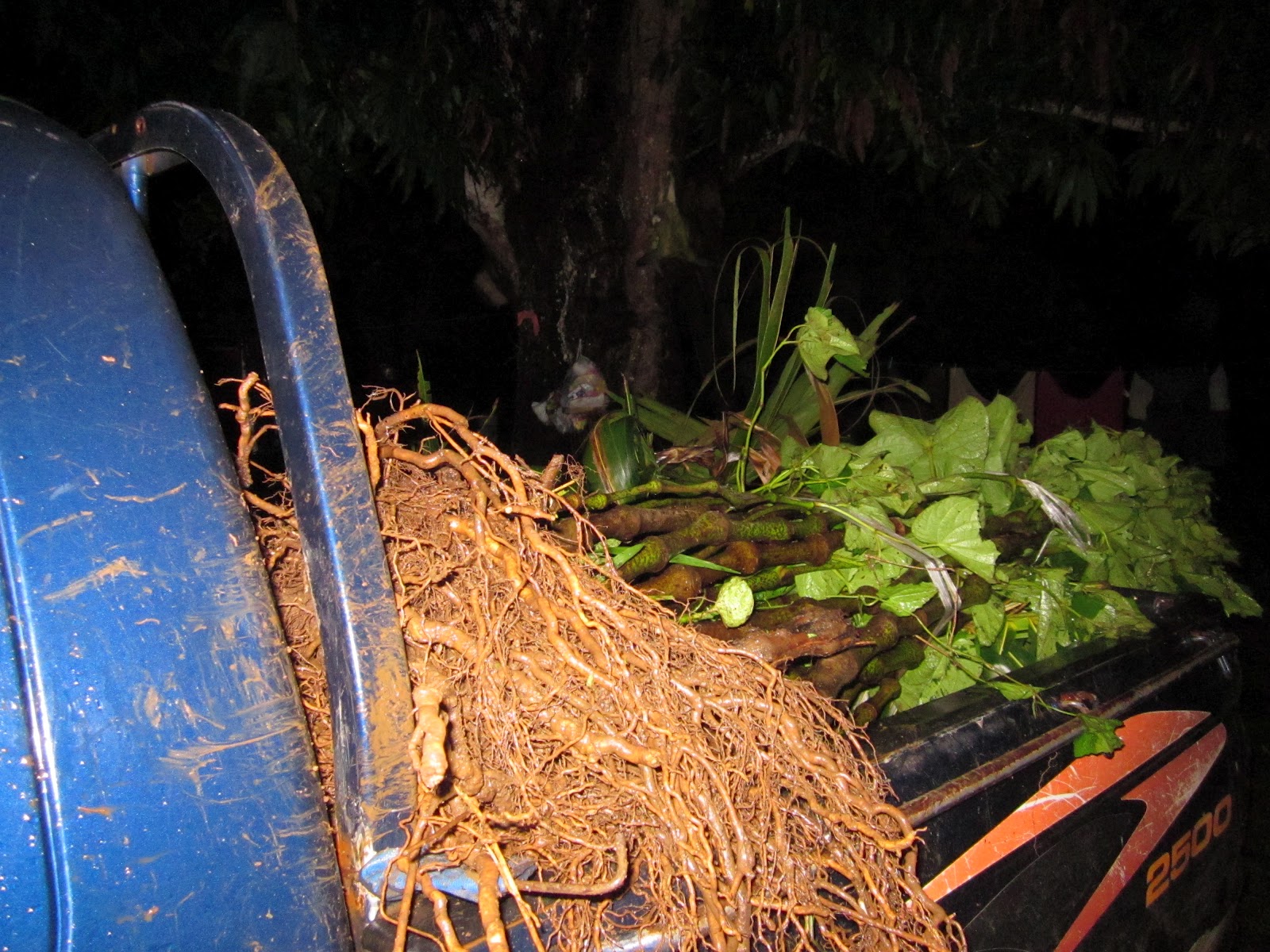
Yaqona root to be presented to Tui Cakau.

Our dead pig, prepared and presented to the rep for Tui Cakau along with the freshly pulled yaqona root, the two whales teeth (tabua), and the 10 bundles of dalo root in order to traditionally and respectfully request permission and support for establishing the tabu areas.

Step 5: Meetings and awareness

We had close to another three months to kill before we would be getting our official approval at this meeting so we tried to keep ourselves occupied by working on the bylaws for our entire qoliqoli, which would naturally include the restrictions for the tabu areas. We had two of our villagers attend a four day training to become Honorary Fish Wardens recognized under Federal Fijian Law. Naturally, I had to attend and get certified as well ;). We used the information we had gleaned on national fishing laws and considered what the village wished for its fishing grounds and used these to write the qoliqoli bylaws.


Working in teams at the Honorary Fish Warden Training to discuss and present destructive fishing methods.

All the newly certified Honorary Fish Wardens! My certificate is hanging in my kitchen.

Walota and Akuila - our two village fish wardens


When June finally came around my group was eager to get provincial approval so we could move on to demarcating the boundary lines. At the right moment, I was shuffled to the front to kneel in front of Tui Cakau to make our case once again but this time the presentation would be geared more towards the other leaders present. It was a bit awkward to do this because it’s apparently extremely tabu to turn your back on Tui Cakau, but he’s sitting at the front with everyone facing him. So my presentation to the attending leaders was made facing away from them. I had to hold my map behind me until my turaga ni koro came up to hold it for me.

Provincial Qoliqoli meeting held in June where our plans for establishing tabu areas was officially and publicly presented and requested of Tui Cakau (he's the one sitting in front of everyone in the back of the picture).
When I was done there was some discussion and what seemed like arguing but I was having difficulty following it or even seeing who was speaking. Eventually, Tui Cakau spoke. He thanked me for our project and the presentation and said that there was general support all around but said the group does have concerns about the supply of food for the local people if we cordon off these areas. He requested that we have a secondary meeting to follow up with the leaders in our direct area to discuss further and to determine if establishing the tabu areas would be directly beneficial to the people or not.

My time for speaking was over. So I had to simply sit and listen to what was said and to thank them once it was concluded. When all I really wanted to do was just debunk all these concerns they had right then and there so we could speak of it, discuss it and be done with it once and for all without drawing it out into more meetings and ceremony. But my respect for these people and their culture held me back, so it was back to the waiting game. 

 *Article from the meeting:


Step 6: Clarifying the benefits of tabu areas

When I heard people saying that they are afraid to implement a tabu area because that would mean they wouldn’t have fish any more I felt terrible. I felt like I didn’t even remotely do a fair job of getting the point across about the benefits of a tabu area.

Our village turaga ni koro and I on our way to Naweni Village for one of our outreach marine and tabu area awareness trips.
So I tried to make very concise points based on the resources I had available to me and present these to people every chance I had, including at those aforementioned follow up meetings. The Ministry of Fisheries even came to the village for a partnered workshop on marine awareness at which we hosted representatives from villages all up and down the coast from us.

  • Protecting just 1/5 of your qoliqoli with the minimum size dimensions of 1 km x 0.5 km will increase your fish catch in the remaining fishing grounds by 60 % within the first three years.
  • The boundary is for us, not the fish. They have a protected area to spawn and for juveniles to grow but they don’t know it’s protected; they’ll still swim in and out at will. As more juvenile fish grow and fill up the tabu, the amount that swim out will continue to increase. It’s the spill over effect.
  • Protecting the mangroves is crucial for two reasons – 1) mangroves are prime real estate for fish nurseries and will greatly increase the efficiency of the tabu area recovering fish populations; 2) everything we do on land has an impact on the sea- using herbicides/pesticides, burning mangrove trees, throwing trash and other wastes, penning pigs within the mangroves, all of it washes to the ocean potentially increasing the nutrient content and instigating algal blooms, which can out compete corals.
  • We want more than one tabu area primarily to benefit marine organisms that are sessile (fixed in one place) that adopt broadcast spawning as their method of reproduction. One of the more threatened species in our waters is the giant clam, a broadcast spawner. Say that there’s one clam in the protected area and it releases its eggs and sperm into the current; if no other clams exist close enough down stream (because they’ve all been fished out) then reproduction won’t occur. Having two tabu areas within relative proximity increases the recovery possibilities of organisms such as these.
  • The combined protected marine and terrestrial habitat from our two tabu areas is roughly 5.43 km2. This sounds like a lot until you consider that the entire village owned fishing grounds is nearly three times this size, which allows for ample opportunity to fish elsewhere.
  • The most important point I tried to impress upon all my audiences is that recovery and benefits may start off slow but that’s no reason to scrap the project; sometimes it takes a small sacrifice now to glean greater benefits in the future. This concept is one that many here struggle to grasp – they don’t see beyond today; they don’t consider future generations, what they’re leaving for their children

Presenting our tabu area project to members of villagers from up and down the coast participating in the marine awareness training that our village hosted.
Some of our villagers presenting about threats to the marine environment and possible solutions at the marine awareness training in the village.  

Member of the Ministry of Fisheries assisting our project by acquiring GPS coordinates during the marine awareness training.
Following these awareness sessions, we attended the next provincial qoliqoli meeting just last week. Again concerns were raised about our tabu areas and tabus in general but this time they gave me an opportunity to respond. And respond I did. When I was finished talking there was not a hand raised in the house. After that there was discussion about other villages wanting to establish tabu areas as well. Tui Cakau asked if the province could use the bylaws that we created in our village as guidelines for other villages looking to structure their qoliqoli and to properly establish tabu areas.

At the end of the meeting he requested to speak with me in private. Well as private as you can be when you are sitting in front of an entire crowd of people who were all trying to look busy. He shook my hand and thanked me for the work that we were doing with our project; he said that this is what the province really needs is something concrete and in black and white – structure, a guide, a means to help the villagers protect their marine resources and clear reasoning as to how such actions will help. He told me he is happy that my village is happy and wondered if he could burden me to do some workshops with other villages looking to set up tabu areas, because it’s good to conserve our environment like this - we have to look to the future after all. He paused and smiled at me. Deciding that bursting into tears of joy would qualify as overreacting, I simply said that I would be happy to help.

So within the coming month I will be traveling with two members of my committee to conduct workshops on how to set up a locally managed marine protected area. Who knows how far this chain reaction can go.

Step 7: Demarcation

We officially placed our first set of boundary markers on August 9th. I say first set because right now they are simply sticks with white flags stapled to them and we are hoping to replace them with buoys if we can collect enough of them.


Villagers placing sticks in dead coral and boulders to use as initial boundary markers.
Placing the boundary markers.
Zebra shark in the tabu area :)

Searching for appropriate holes to place the boundary markers in and we found an octopus!
Dinner!
The day we went out we were joined by the talatala (our district’s Methodist priest) who blessed the boundary markers and more or less made the start of our tabu area official. Naturally, upon completion of this task we hunkered down for a long night of grog drinking, guitar playing, and overall celebration.

The talatala (Methodist preacher) blessing the official demarcation of our tabu areas. This act more or less solidifies the tabu areas as being complete.

Step 8: And now?

And now what? Well, aside from trying to tweak things like the boundary markers and attain things like binoculars for monitoring purposes, we are looking to develop our tabu areas by starting giant clam and sea cucumber breeding programs. If we manage to take off with these two projects they will primarily be used to recover native depleted populations and then eventually they will be used as an income generating activity (particularly with the sea cucumbers). By farming these guys instead, we can better protect native populations and the villagers will still be able to earn money from them that can be used on other development projects.

Whew. Ok, if you made it all the way to the end here and somehow it still wasn’t enough for you feel free to contact me to see more pictures, our qoliqoli bylaws or the data analysis from our transect surveys, or if you simply want to impart any advice!