This will likely be an earnest, though potentially infrequently updated, account of my adventures, tribulations,
and everyday experiences as I spend two years working as an environmental Peace Corps volunteer in Fiji

You'll actually look forward to your morning commute. Life is calling. How far will you go? Learn more about the Peace Corps

Sunday, May 13, 2012

Words from this post: John Candy, SCUBA diving, thumbnail


 Twelve months. Twelve months?! It’s nearly been a whole damn year since I moved in with a small village in Fiji! As another PCV recently put it – “The days feel like months and the months feel like days” – I could not put it better if I tried. And all this time I’ve been doing my darndest to get a real understanding of the Fijian village way of doing things. I’m about as close to really getting it as I am to being tall enough to work in Penguins.    

Truth is, life in the village can be very intense and challenging but never in a way you expect. Resources and funding may not be as abundant as the mosquitoes on this tropical island and we may not move in our projects as quickly the average Fijian flocking to the grog bowl but work has a way of being accomplished at its own pace.

A friend of mine who enjoys giving me quizzes to answer via facebook messages (usually questions along the lines of – if my life was a movie what would the title be? or should I (I being my friend) hit on the girl with blond hair or the one with a PhD?) recently asked me what was the biggest thing I’ve learned since becoming a Peace Corps volunteer.

Well, Alex:


The Biggest Thing I’ve Learned Since Becoming a Peace Corps Volunteer in Fiji
By: Christine

The biggest thing I have learned since becoming a Peace Corps Volunteer in Fiji is to never expect that a fruit smoothie bought in town will not have a finger nail as an ingredient.

The End.


…Actually, I feel that that really sums up a lot in just a few words even though I’m joking…sort of. Alright, since I know you’ll just be wondering about it throughout the rest of this blog post I’ll just say that yes, I did indeed suck up a thumbnail through my straw and chew on it for a minute or two wondering what it was before removing it and discovering with something less than delight that their secret ingredient may or may not have been growing fungus.

But anyway.

The second most significant thing I’ve learned is very simple and a bit cliché so I apologize in advance, but it’s very true – to actually get work done while living in a remote little village, just go with the flow! Granted, often the flow here is as quick as concrete but every once in a while there are bursts of great productivity and development with the village and it can come at the most unsuspecting moments.

Therefore — you should relax to the pace of the village and let life come at you as it will but be ready on the balls of your feet to give a presentation in the native tongue about the process and importance of locally managed marine protected areas to village representatives from the entire province at six in the morning eight villages away, which you only learn about because someone is knocking on your bedroom window at four-thirty that morning to, umm, remind you.

~~~

Well, it was this precise skill of going with the flow that allowed me to become a guest on a premier SCUBA diving live-aboard that was cruising throughout the turquoise waters of central Fiji. Not exactly the definition of Peace Corps living but there’s going with the flow for you. And how could it possibly float me to such a desirable situation instead of to my bathroom with another bout of food poisoning you might ask? Well, let me explain officially:

ahem,

Every eighteen months, the New England and Monterey Bay Aquariums lead a joint expedition to Fiji for research on South Pacific coral reef ecosystems, conservation outreach, and cultural exchange. They spend their ten day trip on board the fully outfitted diving vessel, NAI’A, traveling from Lautoka through Bligh Water up to Namena Marine Reserve, all the way down to the southern end of the Lomaiviti group at Gau Island, and then a return passage that has stops at Wakaya, Makogai, and Vatu-I-Ra islands before making berth once more in the Lautoka marina. My participation was spurred on by the desire to get cultural perspective from a Peace Corps volunteer with former ties to the NEAq.

Rough map of the NAI'A's route through Lomaiviti. Original photo from - www.usdivetravel.com/V-Fiji-Naia.html

NAI'A Dive Boat
Looking down from the crow's nest.

Translation – There were people visiting Fiji that like me and they agreed to let me onto their very nice boat so that I could get some exposure to white people and feel normal again while they could hear fascinating stories of what it’s like to live in a village and perhaps actually gain some of that understanding of Fijian culture that I’ve been working so hard to attain.

This is Bailey, without whom I would have continued living in happy ignorance back in my village and would never have ended up in this highly unique and fantastic situation. You'll have to ask him why he has 'weightbelt?!' scrawled across his dive slate...if he hasn't told you already. ;)
Really though, this expedition turned out to be a mind-blowingly amazing experience and was the consequence of good timing and great people. The sixteen other participants on board comprised a magnificently diverse group of marine biologists, senior aquarists and fish curators, professional underwater photographers, and several other talented SCUBA divers interested in marine conservation.

Going out for a dive in one of the skiffs.
Even though the entire crew, with exception to the cruise directors, was Fijian, I managed to become the go-to girl for curious questions about Fijian culture. Undoubtedly, this was because people could probe without accidentally offending someone. Typically the conversations would start simply, often after I had experienced some small form of reverse culture shock, such as spotting blueberries deliciously draped over our french toast one morning for breakfast, having all but forgotten what blueberries taste like. This then would lead to a discussion about the differences in food between our two cultures and then bridge off into the state of agriculture in Fiji and its impact on the economy.
French toast with blueberries. I may have cried...
The majority of each day was spent eating and diving, as such:

6:00 am – wake up, eat a cold breakfast
7:00 am – sunrise dive
9:00 am – hot breakfast
10:30 am – second morning dive
12:00 pm – lunch
2:00 pm – midday dive
3:30 pm – tea/snacks
5:00 pm – sunset dive
7:00 pm – dinner
8:30 pm – night dive
10:30 pm – sleep

Granted we didn’t have to do all or any of the dives that we didn’t want to but I mean come on… how well do you know me? The diving was incredible! I had completely forgotten about my addiction to breathing compressed air and for a long time after I returned to my village I suffered withdrawals. 

The dive board where the divemasters do the briefing before each outing.

The tanks all lined up at the fill station.

The time between dives and meals were chock full of lectures, presentations, and discussions on marine ecology, marine protected areas, and the experiences of yours truly. My hope was that I could provide some knowledge about the Peace Corps with a little more accuracy than the movie Volunteers where Tom Hanks and John Candy play Peace Corps volunteers trying to build a bridge in Thailand while simultaneously fighting off communists, drug lords, and the military. Just so we’re clear I only fight communists during my leave days… We also made visits to villages where they are working on setting up a locally managed marine protected area; and we even made a stop at a fisheries station that is currently farming giant clams and breeding sea turtles, which are both considerably endangered. My village is very interested in implementing a giant clam breeding program in our marine protected area once it’s fully established.
Site visit to Kiobo Village in the Kubulau District on Vanua Levu Island.

Giving my presentation about the goals of Peace Corps, my projects, and life in the village.
Young giant clams (vasua) being grown at the Makogai fisheries research station.

Baby Hawksbill sea turtle at the fisheries station.

However, I think that my most exciting moment on the surface was successfully nailing my first ever real back flip off the 15 ft high guard rail.

Photo Credit: Keith Ellenbogen

I also romped around the boat marveling at niceties like napkins, chairs, and running water that was wonderfully hot. I was instructed in the fine art of making a cappuccino, because there was naturally a cappuccino machine onboard. Underwater, I spent a shocking amount of my time doing photo shoots in all sorts of ridiculous poses (but this was only when we weren’t watching manta rays feeding or hammerheads swimming by).

Reef camo.
Photo Credit: Keith Ellenbogen

Being on this boat with so many white people was also a bit of a shock at first for me, although an enjoyable one; and it has turned out to be an amazing opportunity to share what I have learned with people who were honestly interested and to gain valuable resources and information to bring back to the village in turn. It was certainly an enjoyable trip and as usual I feel as though I am gaining more than giving. Still, there may now be a few offices and homes around the western world proudly displaying colorful little drawings happily created by the children in my village for all the “white people on the big boat.” It is still incredible to me that two such places can be connected on such a level, and yet such a connection has become the norm as a Peace Corps volunteer. I made some new friends, reconnected with some old ones and had one of the most enjoyable experiences of my life.

Checking out the cards and pictures that my village kids made for the trip participants. I also had the students in my environmental club write down some of the things that they've learned about coral reefs so far. Some were a little off but some were spot on :).
Divemaster Jo on the left and Skiff driver extraordinaire Eddie on the right. These guys and all the rest of the crew on the NAI'A really made the trip that much more incredible.

Me and Ernie, one of the friends that I made when I was volunteering and working at the NEAq. He assisted with the implementation of the new (or I guess year old now) shark and ray touch tank and is now working full time with the Design Department at the aquarium on the GOT renovations. Ernie wholeheartedly believes in the work that we're doing in the village, setting up a locally managed marine protected area (tabu area), and he kindly donated to our cause. Because of his spontaneous kindness my project committee was able to travel to Taveuni Island to see the Tui Cakau, the chief of our entire province in Fiji. In order to implement this protected area we need his approval and support. Well, Ernie, we finally made it to see him and we have succeeded in getting his support. With some final touches on the bylaws and boundary markers we will officially be closing off our tabu area on June 21st after the provincial qoliqoli (fishing grounds) meeting.


Monday, April 9, 2012

Going to School Like a Good Volunteer

I guess I didn’t really initiate the church-roof-ladder-building project so I obviously am not claiming it as mine, but since it meant I was doing something instead of nothing I’m going to be brash and say it was work anyway.

Outside of all the aforementioned work I have been doing, I have had the most success doing projects with the primary school that serves our village and the surrounding settlements.

The start of term for schools in the southern hemisphere is in January; they get two weeks off in May and September then summer vacation begins in the beginning of December. At the start of this year’s term I took the 40 minute walk down the beach to the school compound to speak with the headmistress. Apparently, I timed it wrong and school wasn’t over yet, so I tried to loiter innocently outside the headmistress’s classroom. I was just in the midst of a determined examination of the closest piece of cracked concrete, trying my best to be inconspicuous when the headmistress stormed out looking harassed and annoyed. Crap. 

The walk to school.

“Yes?” All the kids ran to the windows and were giggling and staring and being normal obnoxious 8 year olds. “I umm was just… umm, well could I speak with you?” She glared at me, warmly inviting me to continue. Right, so I plowed on. I told her that I was thinking about starting and environment club for the older students (primary school includes classes 1 – 8, which is about equal to our grades 1 – 8) after school and was wondering if I might be able to use one of the classrooms. Her demeanor changed, slightly, and she told me she liked the idea and said we could do it every other Friday starting at 1:15 pm or once the kids put all their bags away.

Success! I gushed my thanks and enthusiasm and she wished me goodbye by spinning on her heel and marching back to her students. I was stoked! Now I had two afternoons every month where I knew what I would be doing! Structure! A plan! I’ll actually be doing something! I went back home and began planning for the first club meeting.

I arrived that Friday a little bit early and was sitting on the porch outside waiting for school to get out. When it did, one of the teachers came out and greeted me and told me I would be using his classroom. All the kids were running around and pushing desks against the wall to make room. Then a few more kids showed up… probably just to help, right? Then the entire classroom next door filed out and into the one we were standing in. The teacher started shouting over the din and demanding that the children sit down on the floor in line and be quiet and to pay attention; apparently they had a Peace Corps volunteer coming to teach classes on environmental education.

…wait what? Somehow, in our lengthy conversation the other day, the headmistress and I had a miscommunication. What I wanted was some space after school where interested students from classes 7 and 8 could come and participate in an environmental club for fun. She interpreted that as the Peace Corps volunteer will be teaching environmental lessons between 1:15 and 2:00 pm every other Friday to every student in classes 5, 6, 7, and 8 and it would be obligatory for them to attend. Sigh. I decided to make the best of it and went ahead and did my prepare club plan for that day with all the students. Some of it was a big flop and it was difficult controlling 35 twelve year olds. But other parts of it were fun.
Since then it has become a bit more class-like but it’s definitely a fun class! We go swimming in the ocean and watch movies and draw pictures and, naturally, eat candy. Write now all the focus is going into learning about the coral reef ecosystem and one of our future projects will be coral farming and building fish houses.


We're reviewing some information about coral reefs that we learned from an environmental movie we watched at the previous meeting. BFC stands for Big Fantastic Club, which is our name. I tried to get them to pick a name for our environmental club, since I was still adamantly calling it a club, but they wouldn't. So I said we're going to be the Big Boring Club unless they change it. Fantastic was the best we could do. I should say too that starting in class one all they speak in school is English.
 
Drawing pictures of what a coral reef ecosystem and the surrounding environment looks like.
The group with the best picture would get stickers on their cards. The students with the most stickers at the end of term get prizes...I have no idea what I'll give them for prizes though. Suggestions??
One of the completed pictures.
After the first club/class was done I wiped a whole lot of sweat off my brow and took a breath. That was way more overwhelming than I wanted it to be. But we all had fun and I couldn’t help but feel a little exhilarated. The last thing that day (we weren’t even the last period of the day) was sports hour. All the kids ran out and started screaming and yelling and all I could think was it couldn’t possibly have been this loud when I was having recess at this age and yet I fully believe it was…maybe your hearing doesn’t fully develop until you turn fifteen? I was going deaf. A bunch of girls ran over to me and were begging me to teach them one of the endless games I apparently know.

Right, ok. Think back to recess…what did we play? The first thing I thought of was red light/green light. So we tried that but it failed several times because the girls couldn’t understand that the first time I spun around and said red light wasn’t the end of the game and meant to start over.

The next thing I thought of was red rover. I was hesitating on this one though because I feel like I remember hearing that schools in the US have banned it as a game at recess because of how many injuries the children would sustain. So I approached the teacher overseeing sports hour and explained the game to him and asked what he thought. “Yeah, that sounds great Tina, vinaka.” …ok, guess we’re a go.

I told the girls the basic rules of the game and had them split into two teams of about 12 girls each and spaced them about forty feet apart. They were holding hands preparing to start. One team shouted, “Red rover, red rover send Salome right over!” The girl they chose was in class one and clearly had no idea what was really going on. She just knew that she was playing with all the girls and that she had to run at the other team as fast as she could.

Away she went, sprinting her little heart out and grinning the whole time. As she approached the line she didn’t slow down. I can’t really be sure what exactly happened next. Either the two girls holding hands pulled away at the last second thus stretching out their arms causing them to literally raise the bar higher…or Salome was just a short little girl whose height was just the right unfortunate tallness so she managed to fully clothesline herself in the face at such a speed that she was forced completely horizontal in the air and continued to fly forward until she landed hard on the ground about a foot behind the line.

Oh lord. I ran over to her and she was still smiling ridiculously, clearly completely baffled at what was going on but pleased nonetheless at being able to play. I asked her if she was hurt but she just got up. It took her realizing that everyone was staring at her for her to get upset and start crying, as if she needed to be told that she should be crying after such an event.

Brilliant. The Peace Corps volunteer is beating up children. They’re never going to let me come back to this school! What do the teachers think? I glanced over to them and they were all just standing there smiling. No big deal. This is Fiji after all where a person could slice half their shin off while cutting in the bush and just tie a T-shirt around it and keep working. Anyway, it seemed to be a situation of no harm, no foul as Salome was fine. The girls kept playing and eventually the entire school got involved in this monstrous game of red rover. I stopped cringing when each child was about to break through and we didn’t have any more eventful take downs. Glad I could be the volunteer to bring another violent sport to Fiji. …well, at least they’re having fun! Mission accomplished.
Most of the school at the end of term celebration last year. This is on the front porch of the main building.

So You Thought You Could Sneakily Work On Projects Behind My Back, Huh?


So, really I think it must seem that all this time I’ve been here all I’ve done is lollygag around the village or get myself involved in some silly adventure but surprisingly enough I do manage to get some project work done every now and then. 

Getting work done...no really! Read on...

By now, I hope that I’ve given you a fairly painted picture of the pace of life and work in the village and consequently how much I, though raring to go, am usually hindered in progressing steadily in projects.

Yet there are those days that make me wonder whether I woke up somewhere other than a small village in Fiji. A week or two ago, I opened my front door in the morning and was confronted by all the men in the village scattered about in front of my house hacking chunks off great lengths of bamboo, beating thick ropy vines with knobbly clubs, and marching around with various tools carrying out various and apparently necessary tasks. I sort of stood there dumbly for a moment, mouth half open, hair frizzed nicely from sleeping in a swamp of humidity, and racked my brain for some special even that this could be revolving around and that I had just forgotten about.


Beating the wadamu to separate out the strands to use as rope.

Shaving down the ends of the mangrove sticks so that they'll fit into the appropriate slots in bamboo.

Tying it together.


But no, let’s be serious, the villagers don’t deign to tell me about the regular village events like this and they only tell me about the important events as they are on their way to it themselves (and be sure to prepare a sevusevu and a speech!)… So this couldn’t be that big a deal or I would’ve probably sensed it coming.

I meandered out and discovered that they were in fact making giant ladders. Two of them! Tall enough to climb close to three stories… I stood there and did a quick scan of the houses in the village, all of which are roughly one story tall give or take a story. Curious? But no! Of course, I should have just turned around – the church roof is obviously the intended target. As I reached this conclusion a villager confirmed my thoughts, telling me that they were going to repaint the roof.

I was waking up bit more at this point and I my brain was functioning slightly faster but I was still baffled, not so much by what they are doing but by the fact that I was standing in the midst of nearly the entire population of our village and they were all steadily and efficiently working together early in the morning to construct ladders for a church renovation project.


See! A real group effort ;)

One of the ladders with sides made of wide bamboo posts, steps made from mangroves, and it's all tied together with a type of vine called wadamu, which means red string.

What?! You are can organize and work like that?? Look at how much work is being done in such a short amount of time! And such coordinated efforts! I was feeling considerably flustered. Why then is it so very difficult to get even a few people to show up to a planning meeting or to go out for an hour to look at a certain fishing site? Well, they’ve made a crucial mistake. Now I know how strongly they can work on a project and I’m going to be on their heels from now on.

It was rather fun climbing up and joining a group hangout session on top of the church roof and taking some aerial shots of the place!
 
That's my house on the far left there. :)


The other half of our village center.


Thursday, March 22, 2012

PART 3?! Good God...


I could see him. He had stopped near the bottom and was just standing there. Oh, please don’t open the ziplock bag and try to turn on my camera. The thought of it was making me anxious so I started calling to him. He turned and looked up at me with a grim your-camera-is-F@#$% sort of look. He made his way back up and over the gap to me. He gave me the bag and I pulled out the ziplock with the camera inside. It was wet but not swimming. I tried to turn it on but to no avail. Cait’iko nomu yaco, magatinamu! I shared my fluency in Fijian swears not really directing it at anything in particular. Oddly enough, though I was upset I was not nearly as upset as I thought I should be. Maika was devastated; he felt terrible because he thought it was his fault. I told him not be ridiculous that he was carrying my bag to help me, that he was physically helping me traverse this absurd rock face so that I wouldn’t be the thing falling off, and that I definitely didn’t blame him.

So, on we went. All ten feet of it. After all that, there was only ten more feet of available ledge before the wall became impossible to continue along. We looked up. The top of the canyon was only about four feet above my head but it was pushing out towards us and unfortunately the top of the wall was not flat but continued on into a steep hill scattered with trees, strewn leaves and covered in slippery mud. Even if we made it to the top with out falling off the rock backwards, if we slipped during the trek up the following hill it would likely take us careening all the way back down and over the edge with no option to stop ourselves on the ledge we were currently standing on. I looked at him and we both agreed that we had been stupid enough for one day and turned around to go back the way we came. 

 ~~~~

The rest of our bush hike was pleasant enough, except for sustaining several dozen bee-sting like bites from some evil, clever, little, black ants that were crawling every where. We couldn’t stop for thirty seconds without letting out a yelp of pain. We crossed several more rivers and struggled up some hills so steep that we practically had to hop our way up from tree trunk to tree trunk. Meanwhile, Maika was pointing out pig footprints dried into the mud and showed me where a pig had just eaten, pointing out the details that made it clear a pig had been there recently.

Eventually, we crested our last hill and were standing atop one of the mountain ridges. We came upon a road that led to Coqe but we opted to skip our rest and just to reroute back home. It took another two hours from there but it was easy going with beautiful views of misty mountains to the north and turquoise blue waters defining the coral reef to the south. So, our pig hunt turned into more of a ridiculous, occasionally dangerous, thoroughly enjoyable, and rather exhausting adventure. Maika was so impressed that I was able to trek along with him so far and not complain or say that I wanted to go back once. I just smiled and told him that he shouldn’t be too shocked, that I am actually quite capable of doing a bit more that just spending a day stuck to my floorboards. Sometimes I just need a good friend to get me out!

PART 2!


We left the little settlement and made our way to a river that we were to follow up until it brought us to the waterfall. We had no troubles along this portion of the trip and I suspect that Maika may have been getting overly confident that the gentleman we just met had been mistaken; although, I was still unaware that we were going to our doom.

…ok, I might be exaggerating excessively, but doom just sounds so desirably intense! Right, anyway, we reached the waterfall after about an hour and were congratulating ourselves at our find. It was a lovely little waterfall with a cool looking cave at the top. In celebration of our hiking and navigational skills we plopped down onto one of the rocks and split a small pineapple. As we sat drinking in our juicy fruit, my curiosity was growing about that cave. I looked over at Maika who knew what I was thinking, smiled, nodded, and then went to cut a path for us to climb up.

The waterfall! Close to the top and on the left is the entrance to the cave.
 
I waited down below and watched until he gave the ok to follow his clear cutting up. It was only about twenty feet high but the bush was thick and steep and rather slippery from mud that never sees the light of day. I made it up quickly and peeped into the cave. It was wide and shallow and the ceiling was littered with these strange circular objects that were hanging down. “Weird.” I said turning to Maika, “What are those? From the bats?” We approached closer and saw that they were actually little bird nests and some actually had little birds in them. “Umm, Maika? Are they all dead?” We stood and stared. It was clear that there were birds in the hanging nests but they weren’t moving and they looked really awkwardly positioned with feathers sticking out weirdly. Maika went up to one and pulled out the little blue bird nestled inside. It was definitely alive and was clinging to his hand like it didn’t know how to fly. It was the kind of movement that you see bats making when they are climbing something. It couldn’t have been much bigger than a hummingbird, and I had just never seen anything like it! Maika didn’t know what they were either and we wondered whether they were just freaky little birds or if they were actually nocturnal?

Hanging nests.
With little birds in them.

I followed Maika back down the path and was very near to the bottom when I reached the last stretch that was about seven or eight feet of more or less a straight drop. It was easy to climb up since there were plenty of holds and roots sticking out to grab onto, but going down was seemingly not as simple. Hmmm. Well only one thing to do right? Just start going and sort it out as you go along. I was doing just that and had positioned my self as if I was going down a ladder when Maika pulls a thick vine that was hanging into the bushes to the side and says, “Here, Tina, use this.” I grab hold of it lean back using my feet as support against the wall and began to work my way down. Snap! There was this precarious pause where I seemed to hover there, it was long enough to shout a choice profanity and a half before I came crashing backwards down the rock. Maika managed to half catch me and we both tumbled backwards into the river.
I wasn’t hurt and I wasn’t upset but I turned to Maika and shouted, “What the hell were you trying to do kill me? …telling me to use the vine to climb down.” He laughed then swore and retorted, “Man, Tina, you weren’t supposed to put all your weight into it! It was just a vine!” I wanted to smack him. :)

Well, after all that excitement we decided that we had wasted enough time fooling around and that it was time to move on. We continued our hike deeper into the bush, following the main river (the water fall was from a side river) as a guide. Several times the bank we were walking along just disappeared and we had to walk or swim across to the other side. Back and forth, over slippery rocks, crunching over gravel that kept getting stuck in my shoes, we steadily trekked on. The further in we got, the darker the sky became. We were getting more intimately involved with the mountain range and it always seems to be raining over the mountains. Maika had taken over carrying my little sling pack because he was able to cross the water and manage to keep it above his head… usually my feet couldn’t even touch. Slowly but surely, the river banks began to disappear altogether and we were forced to work our way up through the river itself. We found ourselves in this steep canyon swimming upstream in water over both our heads, Maika with my pack held in the air above his bobbing head but the current was too strong. The narrow canyon seemed to propel the water more quickly through it, causing it to form rapids and a tumbling flow pattern. 

The start of some canyon.

We huffed and puffed as much as we could towards this rapid but it was a futile effort; we gave up and let the current push us back to the nearest bank. Climbing out we looked back at how far we had come and looked ahead at our only other option aside from backtracking, to go up. Maika threw my bag back over his shoulders and holding his knife in one hand began to climb the rock side. It was easy going at first, no need for hands and with a substantial ledge to walk on but the higher up we went the slimmer this ledge became. Instinctively, our hands sought out useful holds to help maneuver us along. And I began wondering how that farmer could have possibly told Maika that following this river up was the right way to go…

Maika stopped. And I stopped. It was the first time I had really looked down since we started and was shocked to see that we were more than thirty feet up the side. He told me to wait and then made this absurdly long step across what I suddenly realized was a very wide absence of footholds. Maika is about a foot and a half taller than me and it was a stretch for him! He made it to the other side onto a ledge that jutted out only about eight inches. He put the knife and my bag down on a small outcropping and then turned around to grab my hand and help me across. I grasped his right hand tightly in my left, kept my other hand gripping the rock and positioned my right foot as close to the edge as I could go and still support myself. Then I stepped out towards him with a long stride with my left leg. I was about halfway through this procedure when I saw just over Maika’s shoulder the outline of my bag. What was it doing? It seemed to be tilting ever so slightly. And then I realized much too late that it was finding gravity far more attractive than the rock it was sitting on. All too quickly it went from tilting to rolling and finally to plummeting down the rock face into the churning water below. “My bag!” I shouted.

I immediately shifted my weight again and was maneuvering to go down and catch it wherever the river decided to spit it out. But we were too precariously placed across this gap. “Tina, no! Come! Tina, please come!” There was a desperate urgency in his voice, and I heard it. I reluctantly turned around and finished making my way over the gap. Without having a clue what was happening, I suddenly found myself where Maika was standing as he was already making his way back over the gap. I waited. I couldn’t really go anywhere so I just stood there wondering if the ziplock bag I put my camera in would be enough to protect it from drowning. A wry thought crossed my as I noted how completely screwed I would be if Maika decided to not come back.

To be continued…


You're Going Where?! ... Hang On, Let Me Get My Cane Knife - Part 1

Yes, I'm alive. I've been dying to get some posts up for a while now but, ah well, you know the story. So here's the first in what I hope will be several new posts! :)

~~~~


So, for the months of December and January in Fiji it’s absurdly difficult to get any project work done. Why? Mostly because of the holidays - people are traveling or busy harvesting their grog for the big celebrations or just taking extended breaks or, quite typically, it is just too damn bloody hot to move at all so everyone just ends up lying on the floor of their house all day where it’s coolest and unsuccessfully attempt to swat away flies with a coconut leaf fan. 

It was the last week in January, and I had just woken up and began my day by rolling from the bed to the floor to begin a long day of lying there being bored of being bored. I let my cat in and she joined me in what was promising to be a good long session of absolute nothingness when I hear someone knocking on the railing of my porch. I let out a huff. Honestly, don’t people know the protocol for days like this? Stop being the independent thinker by marching around the village visiting with people when we’re all trying to languidly melt through the floor boards in peace.

I got up and went to the door. Being vertical was a strange sensation as was the ten degree temperature difference between where my feet were on the floor and where my head now found itself all of five feet higher – clearly, one of the times that I was grateful for being shorter rather than taller. I managed to sloth myself over to the door and found my friend Maika standing there wearing his big black sunglasses, a thin roll of suki (the locally grown tobacco) sticking out of his mouth, which he was protecting from the wind in an attempt to light, and a machete jutting out from its dangerously wedged position underneath his arm. Maika is the leader of the committee for the marine protected area project we’re working on and I know him better than most in the village; yet, whenever I see him outfitted as thus I can’t help but imagine him looking at home overseeing some high-end cocaine production operation hidden deep in the jungle somewhere. I jokingly told him this once and he said “Thank you, Tina.” I wasn’t sure if he was just saying thank you because that’s what Fijians say after you say or do anything or if because he actually liked the idea of him looking like a dangerous drug lord.

My friend Maika. He's never without his cane knife and a pack of dogs.

His typical look - barefoot, suki and knife in hand, and always looking so casual... or like a drug lord.

Anyway, Maika asked what I was doing and I half-seriously glared at him since he obviously knew that I was busy figuring out the coolest position on my bedroom floor before he interrupted. He smiled when I didn’t say anything and said, “Well, I’m going hunting for wild pigs; want to come?” Say what?! Heat shmeat. I was back outside my house and locking my door having changed and gather a few supplies within two minutes.

Now, to be honest I was not particularly keen on the idea of being directly involved in capturing and killing a wild pig, partly because they are shockingly dangerous (Maika has told me that the pigs can very easily kill his dogs when they are trying to take it down and that he’s lost some more than once), but also because I just don’t enjoy killing animals. However, I was not going to pass up this opportunity to go romping around on an adventure deep in the jungle, especially when I had such an enthusiastic and willing guide.

Off we went. Since, my house is in the candy portion of our lollipop shaped village, we had to walk by half the houses on the way out. Everyone we passed unsurprisingly shouted out, “Eh Tina! Sa la’o i vei?” (Where are you going?); I responded in kind by telling them we were going to Coqe (thon gay), which is where Maika’s grog farm is up on the mountain side. We had decided we would hunt our way up there have a rest and then come back down. I thoroughly enjoyed the look of shock and disbelief that every person showed when they heard our plan, particularly that their white, female, kaivalagi volunteer was going so far into the bush and back in one day. Even most the villagers aren’t physically or mentally able to do that.

It was impossibly hot. The good thing, though, was that once we were under the cover of the trees the shade would make it substantially cooler and there were plenty of rivers to jump into to get wet and cool off along the way; the bad part was that we had to walk about a mile up the main dirt road before we reached the right turnoff into the bush. The sun was scorching even though it was only about 8:30 am and we had to repeatedly step off to the side for a quick nip in the shade. During one of these brief respites, we had just come around a turn in the road and were standing off to the side when a bull came quickly trotting by. Curious, but not altogether that surprising. Then we heard shouting and running and a few seconds later a couple of guys came trotting around the corner after it, carting with them three other cows and a calf.

The main road.

Cooling off in one of the many rivers we would soon come across.


Apparently, they were trekking five miles up the road to another village to deliver the cows and were having issues controlling them. So we jumped in to give them a hand. At that moment the bull decided to seek a bit of shade himself and went stomping off into the trees. All four men and Maika thrust their ropes into my hands to hold the remaining cows and went tearing after the bull to try and bring it back. It was a rather awkward and bizarre spectacle. There was me just standing in the middle of the deserted road in the middle of three mooing cows and a calf, staring at the trees where there was a lot of shouting, loud mooing, and tree breaking noises emanating back. Then I heard a new noise. Is that a bus? Crap.


I started moving to the other side of the road and was struggling to bring my herd with me. The bus was rumbling closer but it hadn’t hurtled around the bend just yet. Come on dammit! It was just the calf that was putting up a fight. It seemed scared while the other cows just followed the pull of their ropes like good little domesticated livestock. Three were safe. I went back into the road and started to shove this stupid cow with all my might into the ditch on the side of the road where the rest had clustered. There was the bus. Move! And it did. Finally. And I pushed it into the ditch and followed suit as the bus sped past and I got a multitude of extremely curious stares. It passed and I saw the men coming out of the bush across the road leading the bull. Maika looked up and across and spotted me standing on the other side in the middle of our tight little huddle of noisy cows and he started laughing.

We continued to help them until we reached our path and then bid them adieu as we turned off into the bush. Happily it hadn’t rained for a few days so the route we were taking was blessedly dry and easy to walk on. We continued along it for roughly thirty minutes, laughing and joking and sharing stories about our respective cultures until we eventually reached the first settlement of houses where people stay when working on their farms. We stopped for a quick chat with one man there who usually stayed in a village that was about an hour drive from ours; he traveled to his farm house by riding horseback across the small mountain range that lies between. Maika had been asking him in Fijian how we could get to a nearby waterfall on our way up to Coqe, since Maika had never been to it before and thought it would be nice to show me. 

The four house farmers' settlement
Apparently, this guy knew it well and told Maika two ways of getting there and then onto the farm, one of which he said was rather dangerous and he didn’t recommend it. I of course was blithely unaware of what was being exchanged in this rapid Fijian conversation. I only found out about the wrong way from Maika about an hour and half later as we were discovering just how dangerous that particular route was.

To be continued…


Sunday, January 15, 2012

Do They Celebrate Christmas in Fiji?

Why yes, they do.

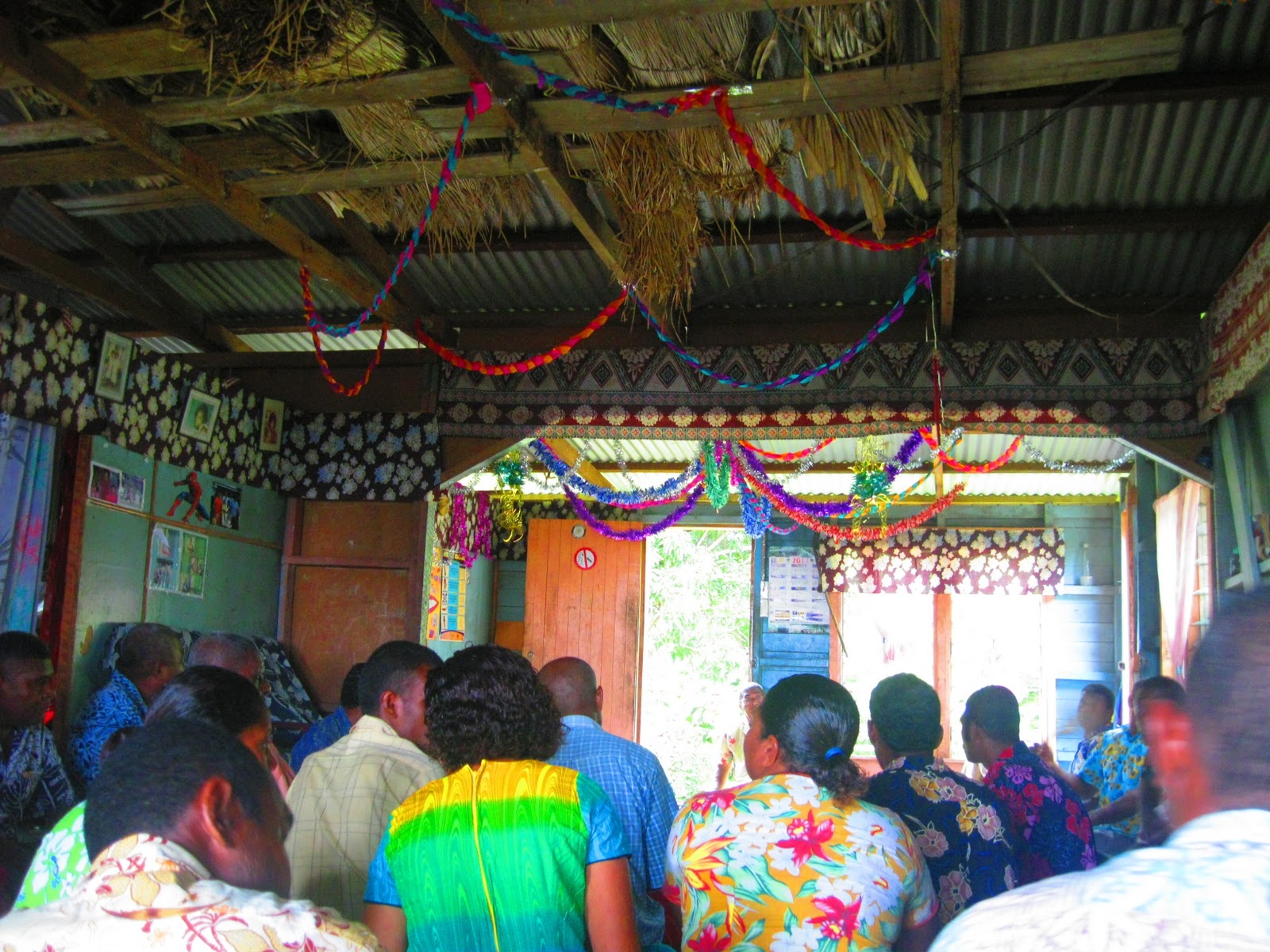
The largest religion in Fiji is Christian (the second being Hinduism) and the largest denomination of which is Methodist. Every village has a church that everyone attends every Sunday and sometimes other days of the week as well.

Do they celebrate Hanukah?
            No, most Fijians have never even heard that term before and I think that most of their exposure to Judaism is through foreign volunteers.
            I visited another PCVs village during Hanukah where a group of us fried up a bucket of latkas (made with cassava instead of potato) with apple sauce to dip and some jelly donuts (stuffed with banana jam) and shared it with some of the villagers as a cross-cultural/religious event. They loved the food and my friend was even able to tell the story of Hanukah in Fijian!

We also baked a pumpkin pie on the stove top…but that was just for us.

The crust we made from mashed bread fruit, which tasted pretty good but took far too long to cook.
 
Do you string up coconut trees with Christmas lights?                  
            You mean like the Corona commercial? Well, first of all, have you ever actually seen a mature coconut tree? Like, in real life? Most of them are absurdly tall even with a lopsided direction of growth (which most of them have-maybe from the wind?). There are no branches except the palm fronds on the very top. I don’t know about you but I was never very good at the “climb a thick, bare, and absurdly tall tree trunk like Mulan” exercise in gym class. However, that’s just me… and probably all the other white people in Fiji.
Native Fijians, though, are amazing tree climbers. It’s nothing out of the ordinary, for instance, to be walking along a village road and pass under a giant mango tree that a dozen or so Fijians have scaled in order to pluck the best fruits from the most unreachable locations and drop them down to their partners waiting below. And I have indeed seen eleven year old kids monkey their way up coconut trees to cut down the fronds for making brooms or to knock down mature coconuts. I’ve seen this in person so you think I would be able to explain to you how they manage to do it, but I can’t—they just sort of shimmy up using only their hands and feet. Unfortunately, there are no extension-cords long enough to travel the same height for a string of lights and even if there were, having a place to plug them in is an even rarer find.  
So, then, the answer is no.

But that didn’t stop me from decorating my own house with some cheap baubles I found in Suva. I had all the village children come over to help and we made a big event out of it one night a few weeks before Christmas.
My front door :)

The morning sun makes this one rather hard to see but there are several ornaments hanging!

Do you sing carols?

            Only in church…or I suppose I do when I’m in the shower.


Church getting out on Christmas day.
 Do you give gifts or cards?
            No, people just provide ample food and grog and share it all around. Usually, food with family and anyone walking by that wants to come in and grog with everyone.

What do you actually do on Christmas?
            1) Eat lots of food that you usually wouldn’t get in an everyday meal. This includes beef, pork, and chicken, which are generally only slaughtered and eaten for important events (holidays, weddings, and funerals). We also were treated to juice. Typical meals in the village will often be abundant in whatever food is available but almost always lacking in beverage. I’ve noticed that Fijians hardly ever drink any liquids (except for tea and of course grog, which is actually a diuretic), so if I ever dine at another’s house I’m sure to bring my water bottle. However, special events usually mean that we’ll get to drink juice. Juice means Tang. And usually they add sugar to it. Indeed their taste for sugar can be so strong that they would prefer this powdered drink with extra sugar to a mash up of passion fruit, mango, papaya, and banana mixed with some water and honey, which I once made and brought to an event...it stood more or less neglected next to the nearly empty jug of tang. But I drank it so that it wouldn’t feel sad and unwanted. Also, alcohol is not permitted in the village.


            2) Go to church. We do a lot of singing in church including some songs that I know from home (aka O Come All Ye Faithful, which I almost started crying to when they began singing in church) but naturally it’s in Fijian. No where else in the world will you hear women capable of such dazzlingly high soprano voices or men with such incredibly low baritones. It’s always an awkward event for me since I can usually sing best when I’m following someone else’s singing and since I can’t even remotely reach these two extremes I end up croaking out some noise somewhere in between and hoping that no one is standing near enough to hear it.  
            3) Drink grog. All day and all night…and if you’re still drinking grog into Boxing day that is perfectly acceptable as well…or into the day after Boxing day. But usually by that point most people slip into a grog coma, upon waking up from which they start drinking grog again. But it is a big village wide party in the chief’s house where everyone is dressed nice and the children are running around, the women are selling chasers (lollipops and the likes), a couple people are playing the guitar, the ukulele and singing, someone is walking around putting baby powder on people’s faces, and everyone is drinking grog. It’s usually a downright raucous party that everyone enjoys and gives everyone ample opportunity to joke around.
Lots of color.
Drinking grog can definitely be a challenge...especially when you are on your 32nd bowl.

Baby powder gets everywhere.

Passing out the grog.
Well in case I haven't said it yet: Merry Christmas and Happy Hanukkah and Happy Holidays to all! And to all a bright sunny tropical day! :)